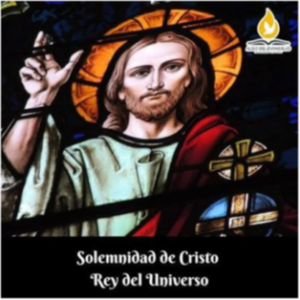
The Solemnity
of Our Lord Jesus Christ,
King of the Universe
Reading 1 Ezekiel 34:11-12, 15-17
Thus says the Lord GOD: I myself will look after and tend my sheep. As a shepherd tends his flock when he finds himself among his scattered sheep, so will I tend my sheep. I will rescue them from every place where they were scattered when it was cloudy and dark. I myself will pasture my sheep; I myself will give them rest, says the Lord GOD. The lost I will seek out, the strayed I will bring back,the injured I will bind up, the sick I will heal, but the sleek and the strong I will destroy,shepherding them rightly. As for you, my sheep, says the Lord GOD,I will judge between one sheep and another, between rams and goats.
Responsorial Psalm Psalm 23:1-2, 2-3, 5-6
- R: The Lord is my shepherd; there is nothing I shall want.
- The LORD is my shepherd; I shall not want. In verdant pastures he gives me repose.R.
- Beside restful waters he leads me; he refreshes my soul. He guides me in right paths for his name’s sake.R.
- You spread the table before me in the sight of my foes; you anoint my head with oil;my cup overflows.R.
- Only goodness and kindness follow me all the days of my life; and I shall dwell in the house of the LORD for years to come.
Reading 2 1 Corinthians 15:20-26, 28
Brothers and sisters: Christ has been raised from the dead, the firstfruits of those who have fallen asleep. For since death came through man,the resurrection of the dead came also through man. For just as in Adam all die,so too in Christ shall all be brought to life, but each one in proper order:Christ the firstfruits; then, at his coming, those who belong to Christ;then comes the end, when he hands over the kingdom to his God and Father, when he has destroyed every sovereignty and every authority and power. For he must reign until he has put all his enemies under his feet. The last enemy to be destroyed is death. to the one who subjected everything to him, so that God may be all in all.
Gospel Matthew 25:31-46
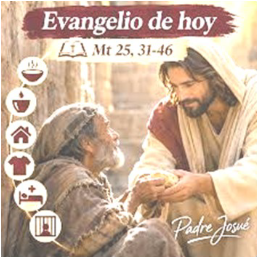 Jesus said to his disciples: « When the Son of Man comes in his glory, and all the angels with him, he will sit upon his glorious throne, and all the nations will be assembled be-fore him. And he will separate them one from an-other,as a shepherd separates the sheep from the goats. He will place the sheep on his right and the goats on his left. Then the king will say to those on his right, ‘Come, you who are blessed by my Fa-ther. Inherit the kingdom prepared for you from the foundation of the world. For I was hungry and you gave me food, I was thirsty and you gave me drink, a stranger and you welcomed me,naked and you clothed me, ill and you cared for me,in prison and you visited me.’ Then the righteous will answer him and say, ‘Lord, when did we see you hungry and feed you,or thirsty and give you drink? When did we see you a stranger and welcome you,or naked and clothe you? When did we see you ill or in prison, and visit you?’ And the king will say to them in reply, ‘Amen, I say to you, whatever you did for one of the least brothers of mine, you did for me.’
Then he will say to those on his left,’Depart from me, you accursed, into the eternal fire prepared for the devil and his angels. For I was hungry and you gave me no food,I was thirsty and you gave me no drink,a stranger and you gave me no welcome, naked and you gave me no clothing,ill and in prison, and you did not care for me.’ Then they will answer and say, ‘Lord, when did we see you hungry or thirsty or a stranger or naked or ill or in prison,and not minister to your needs?’ He will answer them, ‘Amen, I say to you, what you did not do for one of these least ones,you did not do for me.’ And these will go off to eternal punishment,but the righteous to eternal life. »
WHAT’S DECISIVE ISN’T RELIGION
The parable of the «final judgement» is in reality a grandiose de-scription of the final verdict over human history. It’s not easy to re-construct Jesus’ original story, but the scene allows us to grasp the «revolution» that he introduces into the orientation of the world.
There are people of all races and peoples, of all cultures and relig-ions. We’re going to hear the last word that clarifies everything. Two groups go about emerging from that crowd. Some are called to re-ceive God’s blessing: they’re those who have compassionately come close to those in need. Others are invited to depart: they’ve lived indifferent to the suffering of others.
What’s going to decide the final fate isn’t the religion in which one has lived, nor the faith one has confessed during their life. What’s decisive is living compassionately, helping the one who suffers and needs our help. What was done to hungry peoples, defenseless im-migrants, helpless sick or forgotten prisoners is being done to God Self, incarnate in Jesus. The most pleasing religion to the Creator is the help given to one who suffers.
In the Gospel scene there aren’t pronounced great words like «justice», «solidarity» or «democracy». All these are extra, if there’s no real help to those who suffer. Jesus talks about food, clothes, something to drink, a roof over their heads.
Nor is «love» ever spoken of. To Jesus that ends up a language all too abstract. He practically never used it. Here he speaks of things as concrete as «give to eat», «clothe», «shelter», «visit», «draw near». In the «afternoon of life» we won’t be examined about love; we’ll be asked what we’ve done concretely before the persons who needed our help.
This is Jesus’ cry to all humanity: be concerned about those who suffer, take care of the little ones. In no place is life being con-structed as God wants if there’s no freeing of people from suffering. No religion will be blessed by God if it doesn’t generate compassion toward the least.
José Antonio Pagola
Translator: Fr. Jay VonHandorf