Twenty-eighth Sunday in Ordinary Time
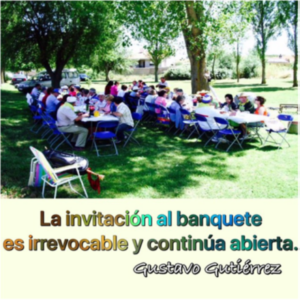
The invitation to the banquet
is irrevocable
and remains open.
Gustavo Gutiérrez
Reading 1 Isaiah 25:6-10a
On this mountain the LORD of hosts will provide for all peoples a feast of rich food and choice wines,juicy, rich food and pure, choice wines. On this mountain he will destroy the veil that veils all peoples,the web that is woven over all nations; he will destroy death forever. The Lord GOD will wipe away the tears from every face; the reproach of his people he will remove from the whole earth;
for the LORD has spoken. On that day it will be said: « Behold our God, to whom we looked to save us! This is the LORD for whom we looked;let us rejoice and be glad that he has saved us! » For the hand of the LORD will rest on this mountain.
Responsorial Psalm Psalm 23:1-3a, 3b-4, 5, 6
R : I shall live in the house of the Lord all the days of my life.
The LORD is my shepherd; I shall not want. In verdant pastures he gives me repose; beside restful waters he leads me;he refreshes my soul. R
He guides me in right paths for his name’s sake. Even though I walk in the dark valley I fear no evil; for you are at my side with your rod and your staff that give me courage. R
You spread the table before me in the sight of my foes ou anoint my head with oil; my cup overflows. ; R
Only goodness and kindness follow me all the days of my life; and I shall dwell in the house of the LORD for years to come. R
Reading 2 Philippians 4:12-14, 19-20
Brothers and sisters: I know how to live in humble circumstances; I know also how to live with abundance. In every circumstance and in all things I have learned the secret of being well fed and of going hungry,of living
in abundance and of being in need. I can do all things in him who strengthens me. Still, it was kind of you to share in my distress. My God will fully supply whatever you need, in accord with his glorious riches in Christ Jesus. To our God and Father, glory forever and ever. Amen.
Gospel Matthew Matthew 22:1-10
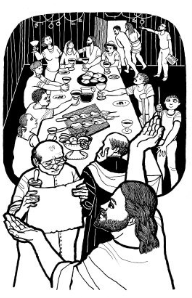 Jesus again in reply spoke to the chief priests and elders of the people in parables, saying, « The kingdom of heaven may be likened to a king who gave a wedding feast for his son. He dispatched his servants to summon the invited guests to the feast, but they refused to come. A second time he sent other servants, saying, ‘Tell those invited:
« Behold, I have prepared
my banquet, my calves
and fattened cattle are killed, and everything is ready;
come to the feast. »‘ Some ignored the invitation and went away,one to his farm,
nother to his business. The rest laid hold
of his servants, mistreated them, and killed them. The king was enraged and sent his troops, destroyed those murderers, and burned their city. Then he said to his servants, ‘
The feast is ready, but those who were invited were not worthy to come. Go out, therefore, into the main roads and invite to the feast whomever you find.’ The servants went out into the streets and gathered all they found, bad and good alike, and the hall was filled with guests. »
GOD’S INVITATION
It seems that the parable of the banquet was very popular among the first generation of Christians, and got recounted in Luke, Matthew and even in the apocryphal Gospel of Thomas. The versions are so different and the applications that are extracted so diverse that we can only ap-proximate the essential elements of the original story.
God is preparing a final celebration for all God’s children, since God wants to see them all seated, next to God, around the same table, en-joying forever a full life. This was certainly one of the images most be-loved by Jesus to «suggest» the final end of human history. He wasn’t satisfied with just saying it with words. He seated himself at table with everyone, and even ate with sinners and the undesirables, since he wanted everyone to be able to tangibly see something of what God de-sired to bring to fulfillment.
That’s why Jesus understood his life as a great invitation in God’s name. He imposed nothing, pressured no one. He announced the good news of God, awakened trust in the Father, banished fears, lit up joy and the desire of God. His invitation ought to reach everyone, above all those most in need of hope.
Jesus was realistic. He knew that the invitation could be rejected. In Matthew’s version the various reactions are described. Some reject it consciously: «They didn’t want to go». Others responded indifferently: «They paid no attention». Their lands and businesses are more impor-tant to them. There were those who reacted hostilely against the ser-vants.
There are many who no longer listen to any call from God. It’s enough for them to respond to themselves about themselves. Without being very conscious of it, they live a «solitary» existence, enclosed in a perpetual monologue with themselves. The risk is always the same: live each day more deaf to every call that could transform their life at its root.
Maybe one of the most important tasks of the Church would be to create spaces and facilitate experiences today where people could listen to God’s invitation proclaimed in Jesus’ Gospel in a simple, transparent and joyful manner.
José Antonio Pagola
Translator: Fr. Jay VonHandorf